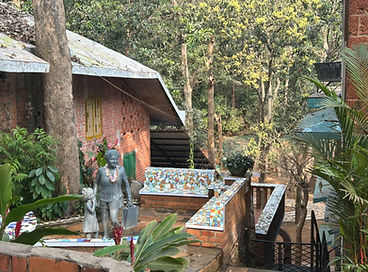
Gnome at work
Aryaa Nayak
Architecture Theory
Learning Through Space: Gerard da Cunha’s Nisha’s Playschool
Aryaa Nayak - 26
“The real dwelling plight lies in this, that mortals ever search anew for the essence of dwelling, that they must ever learn to dwell.” - Martin Heidegger, Building Dwelling Thinking (Heidegger 2001, 163–164)
Architectural space extends beyond function and form; it is first and foremost a lived and embodied experience. Phenomenology in architecture studies spaces not only through visual perception but through movement, occupation, and inhabitation. Dwelling is a fundamental human condition, and architecture mediates between the body and the world, shaping environments through memory, perception, bodily movement, and atmosphere.
This shift from architecture as mere visual form to architecture as lived experience is articulated strongly in the writings of Juhani Pallasmaa, who argues that architecture is experienced by the entire body, not just the eye. As Pallasmaa writes, space is perceived through touch, sound, smell, weight, temperature, and movement, and materials, textures, and the passage of time shape this sensory continuum, reinforcing our sense of being present. Peter Zumthor, in Atmospheres, foregrounds the creation of mood and emotional impact, showing how materials, light, sound, proportion, and detail produce a coherent atmosphere that communicates feeling even before meaning or function.
Gaston Bachelard, in The Poetics of Space , looks at spaces of the everyday such as corners, thresholds, stairs, and homes, highlighting how they shelter memory and nurture imagination. For him, architecture is experienced poetically, becoming a library of personal histories and emotional attachment, privileging subjective experience over function or form. These perspectives frame phenomenology as a tool and way of seeing and understanding architecture as embodied, and experiential.
Gerard da Cunha’s design approach is rooted in an architecture that privileges experience over spectacle. Shaped by his early association with Laurie Baker, he developed a practice attentive to climate, material honesty, and the intelligence of building with what is locally available. Rather than treating architecture as an object, da Cunha approaches it as an environment that must be inhabited through senses. His work consistently leans towards natural and recycled materials, porous edges, generous daylight and ventilation, and a careful responsiveness to site.
At Nisha’s Playschool, this approach becomes a way of rethinking how children encounter space, proposing that learning can emerge not only through instruction but through movement, touch, light, and atmosphere. Designed in 1997 for his wife, Nisha da Cunha, an educationalist who envisioned a learning space rooted in nature and everyday experience, the project transforms a simple institutional program into a setting that is playful, protective, and richly sensorial.
Nisha’s Playschool is carefully shaped to belong to its young users, conceived not for passive occupants but for living, breathing, moving bodies. Low brick arches that require adults to bend acknowledge the child as the true measure of the space, while curved and slanted walls invite movement, play and discovery rather than fixed postures of sitting and obedience.
The warm, textured surface of the bricks, rough under the fingers and cool to the touch in shaded corners, adds a tactile dimension to the spaces. Furniture, scaled to small bodies, allows children to inhabit the space with ease, while classrooms open into gardens and outdoor seating, creating a continuous exchange of air, light and sound between inside and outside.
Pops of bright colour appear on windows, walls and climbable elements, not merely as ornament, but as sensory cues that invite touch, curiosity and play. These choices recognise the child not as a static figure placed within a classroom, but as a living body constantly interacting with its environment, adjusting to warmth, light and sound, and shaping the atmosphere through presence and movement. Instead of forcing young bodies to adapt to rigid, adult-scaled rooms, the building adapts to them, offering a haven that reduces physical strain and sensory overload. Space here is not merely seen, but felt through the whole body, a lived environment that supports learning, comfort and imagination.
Light further shapes the character of the building. Skylights, windows and small openings in the brickwork bring in soft daylight across all levels, changing subtly from space to space, brighter where children read and work, softer in quieter corners.
What does it mean for a child to learn in a space that listens to their rhythms of attention and rest? Around open courtyards, classrooms and activity rooms for music, dance and craft form a lively environment, where sound, movement and shifting light become part of learning. Before it announces itself as a school, the building first feels welcoming and playful. Perhaps this is where learning truly begins? Not with instruction, but with atmosphere.
Breaking away from conventional institutional forms, the building includes an amphitheatre made from recycled glass bottles, demonstrating a focus on sustainability and sensitivity to the site. Rather than appearing as a formal institution, it unfolds as a series of small, connected spaces that invite children to move freely and explore. Stairs and slides link different levels, turning everyday circulation into play and discovery. Learning here is not limited to the classroom; it happens through movement, touch and curiosity, making the experience of the building as important as the lessons inside it.
This approach stands in clear contrast to the rigid layouts of many conventional schools, with their long corridors, fixed classrooms and adult-scaled spaces. The government school in Utre, Kolhapur, which was studied as part of this inquiry, reflects this familiar institutional order; a linear corridor lined with classrooms placed next to one another, anchored by a staffroom that quietly reinforces administrative oversight. Movement here is largely directional and supervised, leaving little room for spatial exploration.
Why must a school discipline the body before it frees the mind? At Nisha’s Playschool, architecture encourages independence rather than control, exploration rather than obedience. Over time, these spaces become shelters for memories and emotions.
Yet one might ask whether such carefully crafted, child-centred environments are a genuine alternative to mainstream educational architecture, or a rare privilege available only within small, well-resourced contexts. Here, I’m thinking of children studying in government-run schools, often denied the opportunity to spend their formative years in such wholesome and inspiring environments; such a model may remain an aspiration rather than a reality. In a system that continues to prioritise efficiency, surveillance and standardisation, the playschool risks remaining an isolated ideal.
Even today, the playschool feels radical in the way it rethinks education. What if learning is not something that happens only through lessons, but through movement, touch and atmosphere? Da Cunha’s design demonstrates how architecture can shape not only behaviour, but imagination and emotional growth. In this sense, Nisha’s Playschool is not simply a building for education, but a place where learning is lived rather than merely taught.
References
Bachelard, Gaston. 1957. The Poetics of Space. Translated by Maria Jolas. N.p.: Penguin Publishing Group.
Caudill, William W. 1961. Toward Better School Design (Classic Reprint). N.p.: Fb&c Limited.
Cunha, Gerard D. n.d. Nisha's Playschool. Torda, Goa.
Heidegger, Martin. 2001. Poetry, language, thought. N.p.: HarperCollins.
Norberg-Schulz, Christian. 1980. Genius loci : towards a phenomenology of architecture. N.p.: Rizzoli.
Pallasmaa, Juhani. 1996. The Eyes of the Skin: Architecture and the Senses. N.p.: Wiley.
Zumthor, Peter. 2006. Atmospheres: Architectural Environments - Surrounding Objects. N.p.: Birkhäuser.